
Adult Speech Therapy: What Does an SLP Actually Treat?
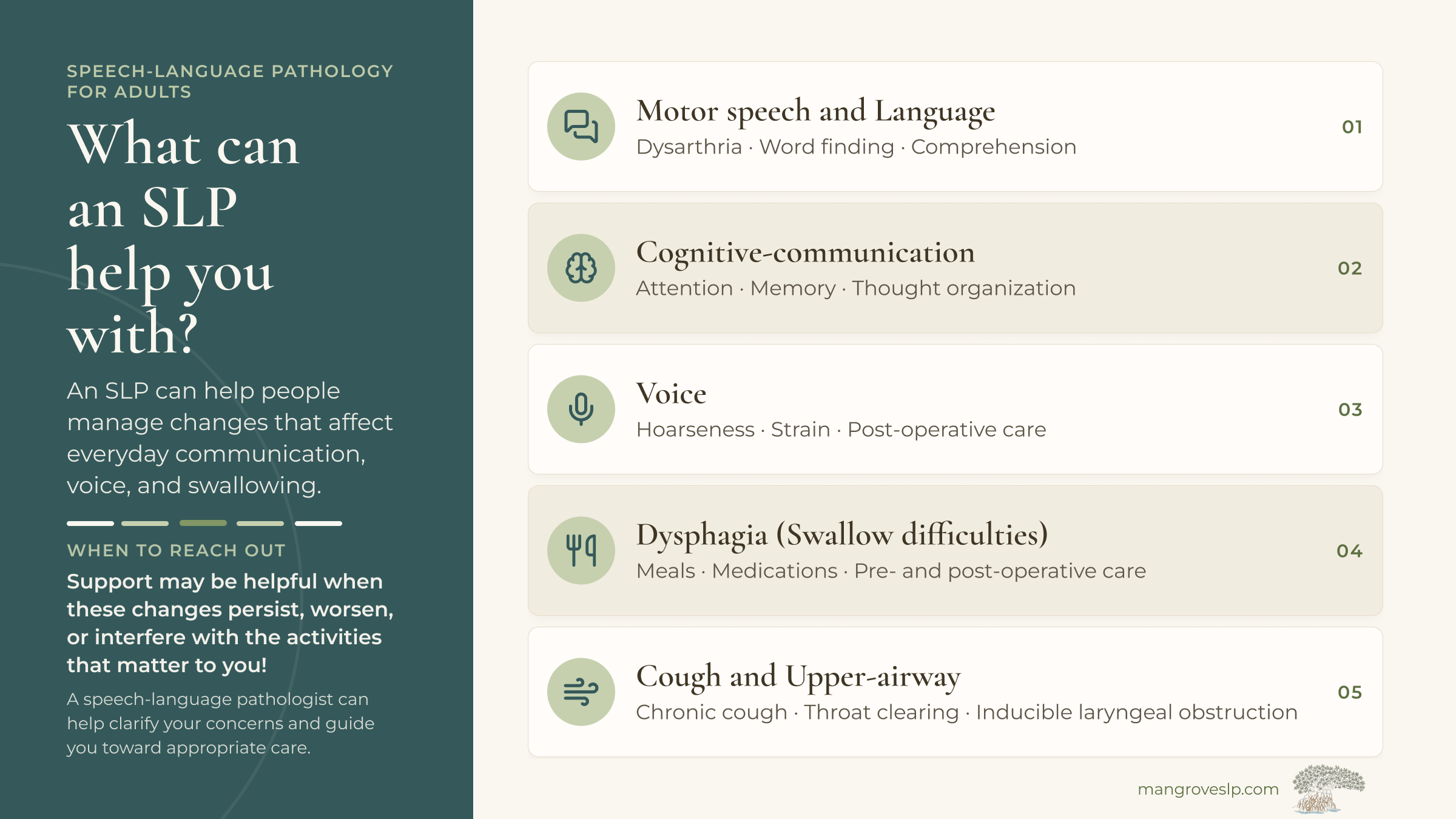
Voice fatigue, word-finding difficulty, coughing during meals, and changes in memory or communication may all fall within the work of an adult speech-language pathologist.
When most people hear the words speech therapy, they may think of children learning to pronounce certain sounds. That is one part of the profession—but it is far from the whole picture.
Maybe your voice gets tired before the end of the day. Perhaps you have trouble finding words after a stroke, cough during meals, or feel that your memory and communication have not been the same since a concussion. These concerns may seem unrelated, but they can all fall within the work of a speech-language pathologist, also called an SLP.
When it is hard to find words or speak clearly
Communication changes can look different from one person to the next. You may know what you want to say but struggle to find the word. Your speech may sound softer, slower, slurred, or less clear than it used to. You may also have difficulty understanding conversation, reading, or writing.
An SLP may help with:
- Aphasia
- Difficulty speaking, understanding, reading, or writing, often after a stroke or brain injury.
- Dysarthria
- Speech that becomes less clear because the muscles used for speaking are weak or difficult to coordinate.
- Apraxia of speech
- Difficulty planning the movements needed to say words, even when you know what you want to say.
Therapy is connected to everyday life. Goals might include having a conversation with family, speaking more clearly on the phone, returning to work, or finding another reliable way to communicate. Research supports speech-language therapy for improving functional communication after stroke, and stroke rehabilitation guidelines recommend individualized treatment for people with aphasia (Brady et al., 2016; Richards et al., 2026).
When thinking and communication change
Thinking and communication are closely connected. After a concussion, stroke, brain injury, or neurologic illness, you may have more difficulty following conversations, remembering information, organizing your thoughts, staying focused, or completing tasks with several steps. SLPs call this area cognitive-communication.
Therapy may include practical ways to organize information, reduce distractions, remember important details, pace demanding activities, and manage daily routines. Evidence-based cognitive rehabilitation supports treatment of attention, memory, executive functioning, language, and social communication following stroke or traumatic brain injury (Cicerone et al., 2019; Togher et al., 2023).
When your voice changes
Voice therapy may help if your voice is frequently hoarse, weak, breathy, strained, uncomfortable, difficult to project, or easily tired. Voice changes may be related to vocal tremor, muscle tension, benign vocal fold lesions or vocal fold weakness, aging, Parkinson’s disease, surgery, intubation, or heavy voice use (Speyer, 2008; Stachler et al., 2018).
When meals become more difficult
SLPs also assess and treat swallowing problems, known as dysphagia. A swallowing problem does not always involve obvious choking.
Consider a swallowing evaluation if you notice:
- coughing or throat clearing during meals;
- food, liquid, or pills feeling stuck;
- needing several swallows for one bite or sip;
- avoiding foods that have become difficult to manage; or
- meals taking much longer than they used to.
An SLP can evaluate how your mouth and throat work together during swallowing and determine whether additional testing is needed. Recommendations may include exercises, changes in positioning or pacing, practical strategies, caregiver education, or carefully considered food and liquid changes. Your health, preferences, routines, and quality of life should all be part of the plan.
Trouble with coughing or breathing
Some SLPs also have specialized training in chronic cough and inducible laryngeal obstruction, or ILO, previously called vocal cord dysfunction. ILO can make it suddenly feel difficult to breathe in and may be triggered by exercise, strong odors, smoke, temperature changes, or other irritants. Treatment may include identifying triggers and practicing breathing strategies that help the throat and vocal folds reopen. Speech therapy may also be part of care for a chronic cough that continues after appropriate medical evaluation (Gibson et al., 2016).
Because coughing and breathing symptoms can have many causes, SLPs often work with ENTs, pulmonologists, allergists, gastroenterologists, and other medical providers. A systematic review found promising improvements in symptoms and laryngeal function following non-medication treatments, although the authors noted that stronger controlled studies are still needed (Haines et al., 2022).
When to reach out
Consider reaching out when changes in communication, memory, voice, swallowing, coughing, or breathing persist or affect daily life. Your SLP will review medical records and use structured testing or real-life activities to better understand what is difficult. The next step may be therapy, education and home strategies, additional testing, or coordination with another provider.
Veronica offers one-on-one adult speech therapy in Clearwater. Start with a complimentary phone call to discuss your concerns and determine the next step.
This information is educational and does not replace medical advice or emergency care.
References
- Brady, M. C., Kelly, H., Godwin, J., Enderby, P., & Campbell, P. (2016). Speech and language therapy for aphasia following stroke. Cochrane Database of Systematic Reviews, 2016(6), Article CD000425.https://doi.org/10.1002/14651858.CD000425.pub4
- Cicerone, K. D., Goldin, Y., Ganci, K., Rosenbaum, A., Wethe, J. V., Langenbahn, D. M., Malec, J. F., Bergquist, T. F., Kingsley, K., Nagele, D., Trexler, L., Fraas, M., Bogdanova, Y., & Harley, J. P. (2019). Evidence-based cognitive rehabilitation: Systematic review of the literature from 2009 through 2014. Archives of Physical Medicine and Rehabilitation, 100(8), 1515–1533.https://doi.org/10.1016/j.apmr.2019.02.011
- Gibson, P., Wang, G., McGarvey, L., Vertigan, A. E., Altman, K. W., Birring, S. S., & CHEST Expert Cough Panel. (2016). Treatment of unexplained chronic cough: CHEST guideline and expert panel report. Chest, 149(1), 27–44.https://doi.org/10.1378/chest.15-1496
- Haines, J., Smith, J. A., Wingfield-Digby, J., King, J., Yorke, J., & Fowler, S. J. (2022). Systematic review of the effectiveness of non-pharmacological interventions used to treat adults with inducible laryngeal obstruction. BMJ Open Respiratory Research, 9(1), Article e001199.https://doi.org/10.1136/bmjresp-2022-001199
- Richards, L. G., Ifejika, N. L., Stein, J., et al. (2026). 2026 guideline for adult stroke rehabilitation and recovery: A guideline from the American Heart Association and American Stroke Association. Stroke. Advance online publication.https://doi.org/10.1161/STR.0000000000000536
- Speyer, R. (2008). Effects of voice therapy: A systematic review. Journal of Voice, 22(5), 565–580.https://doi.org/10.1016/j.jvoice.2006.10.005
- Stachler, R. J., Francis, D. O., Schwartz, S. R., Damask, C. C., Digoy, G. P., Krouse, H. J., McCoy, S. J., Ouellette, D. R., Patel, R. R., Reavis, C. C. W., Smith, L. J., Smith, M., Strode, S. W., Woo, P., & Nnacheta, L. C. (2018). Clinical practice guideline: Hoarseness (dysphonia) (update).Otolaryngology–Head and Neck Surgery, 158(1_suppl), S1–S42.https://doi.org/10.1177/0194599817751030
- Togher, L., Douglas, J., Turkstra, L. S., Welch-West, P., Janzen, S., Harnett, A., Kennedy, M., Kua, A., Patsakos, E., Ponsford, J., Teasell, R., Bayley, M. T., & Wiseman-Hakes, C. (2023). INCOG 2.0 guidelines for cognitive rehabilitation following traumatic brain injury, Part IV: Cognitive-communication and social cognition disorders. Journal of Head Trauma Rehabilitation, 38(1), 65–82.https://doi.org/10.1097/HTR.0000000000000835